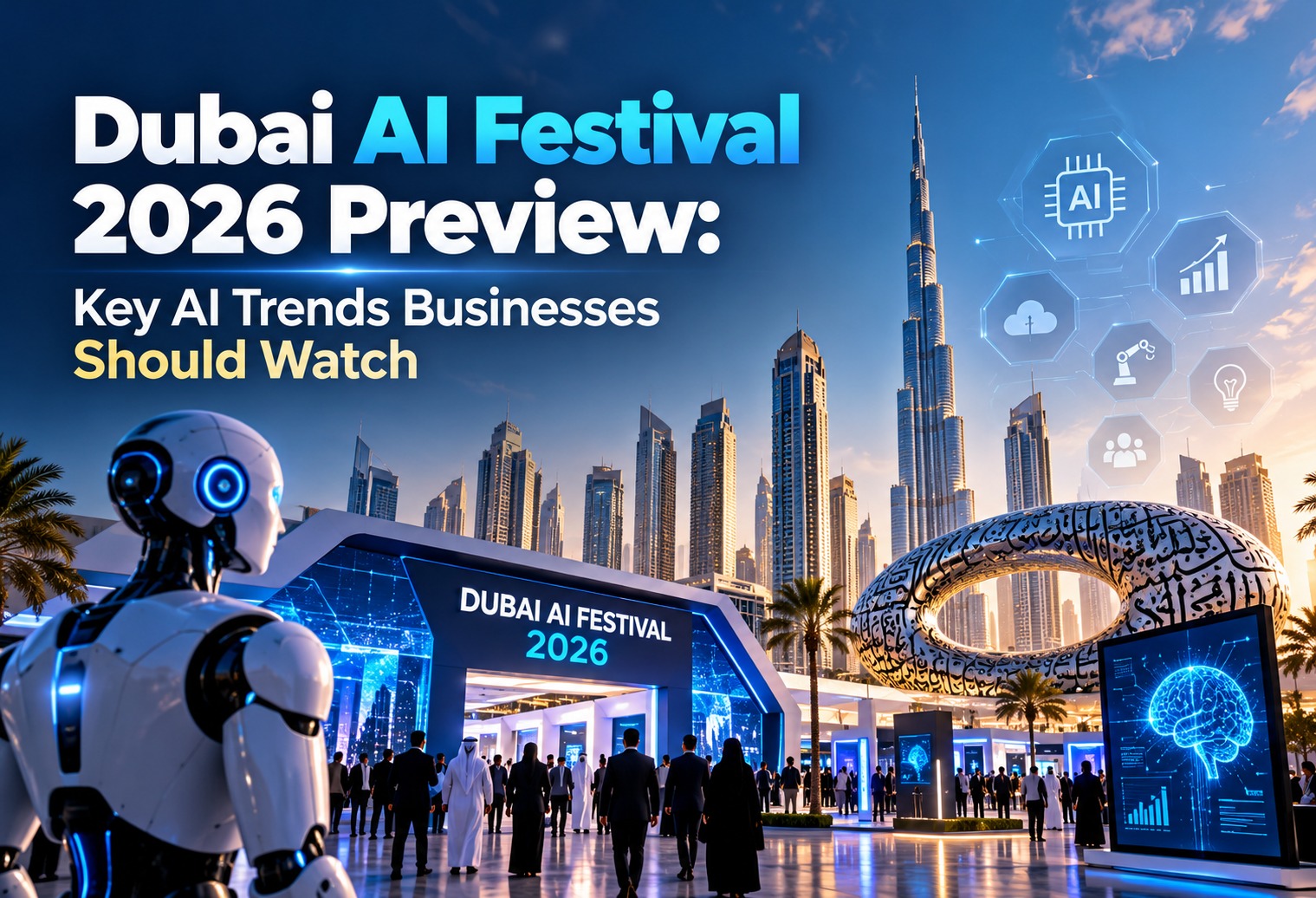
Plenty of businesses are putting money and attention into AI. Picking the right use case and getting it working inside a real company are two separate problems. The Dubai AI Festival runs on 26 and 27 October 2026 at the Dubai World Trade Centre, so this preview from Digitalroar Softlabs covers the themes most relevant to business leaders, founders and technology teams, plus the questions worth carrying into the room.
What Is Dubai AI Festival 2026, and Why Should Businesses Pay Attention?
The Dubai AI Festival is a two-day event that brings together the people funding AI and the people building it. It takes place on 26 and 27 October 2026 at the Dubai World Trade Centre. The published agenda points to AI adoption, investment, governance, infrastructure, industry applications, and the future of work.
Business owners, startup founders, technology leaders, and product teams all have a reason to follow it, because those themes sit right where money, regulation, and real deployments meet. Skip the event history and focus on what each theme means for the decisions you’re making this quarter. Digitalroar Softlabs is following these themes closely, especially for businesses building digital products.
5 AI Trends Businesses Should Watch at Dubai AI Festival 2026
These five trends line up with the published programme. Treat them as areas to investigate, since nobody can promise what any single session will say.
1. Agentic AI & Autonomous Workflows
Most business AI today assists. It drafts an email or summarises a call, and a person finishes the job. The next step is systems that carry out multi-step workflows under defined permissions, such as triaging support tickets and flagging exceptions for review. That can save real time, as long as humans approve the steps with real consequences. Over-automation has its own risk: a mistake repeats at speed, and nobody notices until a customer does. Decide where the approval points belong before deciding how much to automate.
2. Responsible AI and Digital Trust
Data privacy, permissions, explainability, monitoring, security, and accountability are moving out of the legal footnotes and into product requirements. Governance costs far less when it’s designed in from the start than when it’s bolted on after launch. If you can’t say what data a feature touches, who can override it, and how you’d spot it going wrong, it isn’t ready for customers.
3. AI Infrastructure and Investment
A demo that dazzles on a laptop can behave very differently at production scale. Data quality, cloud and computing capacity, integration work, and inference costs all show up once real users arrive. Budget for them early, because cheap prototypes have a habit of turning into expensive production systems.
4. AI-Powered Customer Experiences
Contextual assistance, personalisation, smarter customer-service flows, and intelligent interfaces can make a digital product feel easier to use. They can also add complexity nobody asked for. Where a customer journey has real friction, AI may help. Where a clearer form or a better search bar would do the job, simpler software is often the honest answer.
5. Measurable Business Outcomes
Having AI in a product proves nothing by itself. More companies are judging opportunities by time saved, error rates, customer satisfaction, operating costs, and revenue impact. Measure the result you wanted in the first place.
How Can Businesses Decide Which AI Opportunities Are Worth Pursuing?
Trends only help if they lead to a decision. Run any AI idea through this checklist before it gets budget.
- Name a recurring business problem before choosing a technology.
- Check that the required data is available, reliable, and appropriate to use.
- Compare AI against conventional automation or a simpler software improvement.
- Estimate implementation, integration, maintenance, and oversight costs.
- Set a baseline and success metrics before the pilot starts.
Questions Business Leaders Should Take Away From Dubai AI Festival 2026
You’ll hear plenty of big claims at any AI event. These questions help you sort them. Treat them as things to investigate yourself, because no festival can promise answers to everyone.
- Which AI applications have shown measurable value in a comparable business?
- What infrastructure and integrations do they need?
- How are data security, governance, and accountability handled?
- What do implementation and ongoing operation cost in full?
- What evidence shows the solution scales beyond a pilot?
What Could These AI Developments Mean for Businesses Building Digital Products?
AI features rarely live on their own. They need dependable web or mobile applications, plus the APIs and backend integrations around them, and that’s where plenty of projects stall. Custom software is what connects an AI capability to the workflows a business already runs. Often the sensible route is extending an existing product instead of rebuilding it.
At Digitalroar Softlabs, our work includes website development and mobile app development, along with wider software product work for businesses in Dubai. If you’re weighing what your product needs before it can support new features, that’s a natural place to start the conversation.
The Bottom Line
Five areas deserve your attention at the Dubai AI Festival 2026: autonomous workflows, responsible AI, infrastructure and investment, customer experience, and measurable outcomes. One habit sits behind all of them. Judge any AI idea by the real need it serves, the integration it requires, the governance around it, and the value you can measure. If you’re planning digital products that need to carry AI-driven features, the team at Digitalroar Softlabs is happy to talk it through.


